
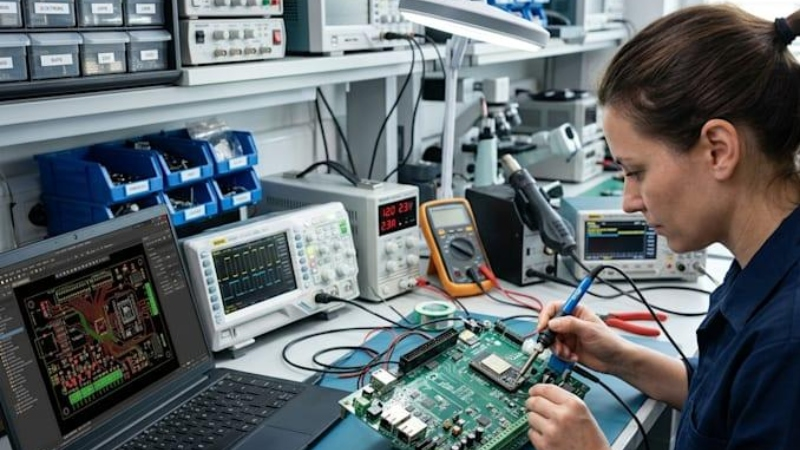
Every few months there’s a new gadget that’s supposed to change everything. Smarter sensors, AI chips, robots that sort boxes. Some of it is genuinely useful. A lot of it is a nice way to spend money you don’t have.
If you’re a startup, the question isn’t “what’s the newest hardware?” It’s “what will fix my problem without wrecking my budget?” That’s what this guide is about. We’ll go through the main types of hardware, what they’re good for, and what to check before you buy.
About this guide
We wrote this after reading through official guidance and technical sources. We haven’t tested these products ourselves so you won’t find product reviews here. What you will find is a practical look at where each type of hardware fits and what startups should check before buying.
What counts as hardware innovation?
Anything physical that does the work: processors, sensors, storage, networking gear, robots, smart devices. The difference from software is simple. A software update changes how a device behaves. New hardware changes the device itself, with a better design, a more efficient chip, or a feature that wasn’t possible before.
Think of a small workshop adding temperature sensors to its machines. Or a shop switching to proper barcode scanners instead of counting stock by hand. Or a startup picking a lower-power processor so its product’s battery lasts a few more hours. None of these are flashy. All of them solve something real.
That’s the test I’d use every time: does it solve a problem you actually have? If not, skip it, however good the spec sheet looks.
Five types of hardware worth knowing
1. Energy-efficient computing
Servers and computers eat electricity, and then you pay again to cool them. A faster processor isn’t automatically a better deal if it runs hot and costs more every month.
Look at power draw, heat, compatibility and how many hours a day the machine will run, not just the headline speed. The U.S. Department of Energy has solid guidance on efficient data center design if you want to go deeper. Even if you only run two or three servers, the basic ideas apply.
Practical tip: if you host your own servers, compare two or three setups on electricity cost over a year, not only the purchase price.
2. Sensors and connected devices
Sensors are probably the easiest place for a small business to start. They’re cheap, they’re simple, and they catch problems early. Typical uses:
- Temperature checks in storage rooms
- Vibration monitoring on machines, so you hear about trouble before it breaks
- Energy tracking across a building
- Status checks on equipment at remote sites
Here’s the catch, though. Every connected device is also a possible way into your network. Before you buy, ask whether the maker still pushes security updates and for how long. A sensor that stops getting updates in 18 months is a liability. NIST’s IoT cybersecurity guidance explains why this matters, and it’s worth a read.
3. AI hardware
This means chips built for AI work, like GPUs and neural processing units. They’re good at image recognition, speech, quality inspection, and analysing sensor data on the device itself.
Honestly, most startups don’t need this in year one. Without a clear task and enough data, an AI-capable device is just an expensive box. Ask yourself:
- What exact task does this improve?
- Does it need real-time results?
- Could the hardware I already own do it?
- What will software, upkeep and replacement cost?
- Does sensitive data stay on the device, or go to someone else’s server?
If you can’t answer the first question in one sentence, wait.
4. Repairable and modular devices
Some devices let you swap the battery, memory or storage without replacing the whole thing. For a startup, that can be the difference between a $60 repair and a $900 new machine. The real saving depends on parts, labour and warranty, so check before you assume.
The EU’s right-to-repair directive shows where policy is heading, with repair becoming easier for many consumer products. When you compare equipment, check:
- Are spare parts easy to get?
- Is there repair documentation?
- What does the warranty actually cover?
- How long will the maker support it?
A cheap price tag can hide an expensive device. If it’s hard to fix, you’ll pay for it later.
5. Automation and robotics
This covers controllers, industrial sensors, machine-vision systems and robots. It works best on repetitive, precise jobs like sorting, inspecting and moving materials.
Most small businesses don’t need a robot. A basic inventory scanner, or a sensor that pings your phone when a machine runs hot, often solves 80% of the problem for a fraction of the cost. If you do go bigger, plan for safety rules, training, maintenance, and the day it stops working. Because it will.
What you can realistically gain
Time. Good equipment cuts manual work and makes repetitive tasks more consistent. Don’t assume, though. Measure it before and after.
Visibility. You see what’s happening with stock, machines and energy, so you spot trouble sooner.
Savings. Efficient hardware can cut power bills, downtime and repairs. Set that against purchase cost, setup, subscriptions and training.
Better products. If you build hardware, newer parts can make your product smaller or more reliable. Test the prototype in real conditions before you call it ready.
A simple way to choose
- Name the problem. One sentence. If you can’t write it, you’re not ready to buy.
- Set the real budget. Include installation, accessories, software, power, upkeep and replacement.
- Compare against your actual workload. Ignore the marketing page.
- Run a small pilot. Write down what goes wrong, what it costs, and what the people using it say.
- Plan for repairs. Who fixes it? Are parts available? What happens when it breaks?
- Check the result. Compare with your original goal using something measurable: time saved, errors, energy, downtime, cost per unit.
Mistakes we see over and over
- Buying specs, not solutions. High performance is wasted if you don’t need it.
- Forgetting compatibility. New parts don’t always work with your current setup.
- Ignoring the full cost. Installation, repairs and training add up fast.
- Skipping security. An unpatched connected device is a risk.
- Scaling too early. One working prototype doesn’t mean you’re ready for mass production.
- No repair plan. If parts are hard to find, the equipment becomes dead weight.
Where this is going
Hardware will keep getting more efficient, more connected and more secure, and AI chips will show up in more everyday devices. That should open doors in manufacturing, retail, logistics and healthcare tech.
But not everything will suit a small team. Some of it will stay expensive or need specialist skills for a long time. My advice is to follow credible sources, test small, and judge everything against numbers you can measure. A secure, easy-to-maintain setup beats a faster one you can’t look after.
FAQs
- What is hardware innovation?
Improvements in physical technology such as processors, sensors, robots and connected devices, which can improve speed, reliability, efficiency or features. - Why does it matter for startups?
It can help you build better products, automate some tasks and monitor your operations. It only pays off if it fits your budget and goals. - Is newer hardware always better?
No. It can cost more and cause compatibility and maintenance trouble. Compare performance, support and total cost of ownership. - How do I test new hardware on a small budget?
Pick one problem, try one or two options on a small scale, record the costs and results, and only then scale up. - What security risks should I check?
Update policy, access controls, data protection, network security and how long the manufacturer supports the device.
Bottom line
Hardware innovation is most valuable when it solves a real problem. Energy-efficient computing, connected sensors, AI-enabled components, repairable devices, and automation equipment can offer useful opportunities, but each option needs careful evaluation.
For startups and established businesses alike, the best approach is to define a clear goal, compare realistic alternatives, test before scaling, and plan for security and maintenance. Rather than choosing technology because it is fashionable, businesses should invest in hardware that provides measurable value to their customers and operations.

Erin Durkheim is a digital content writer and researcher focused on blogging, technology, AI tools, and practical digital guides. Through BloggingHut, Erin shares clear, useful, and easy-to-follow information to help readers learn new tools, improve their digital skills, and work more effectively online.